

What Size Solar System Do I Need?
This is one of the first questions homeowners ask. But with solar, bigger isn’t always better. The right system usually comes down to four key factors: available space, electrical needs, budget, and local regulations.
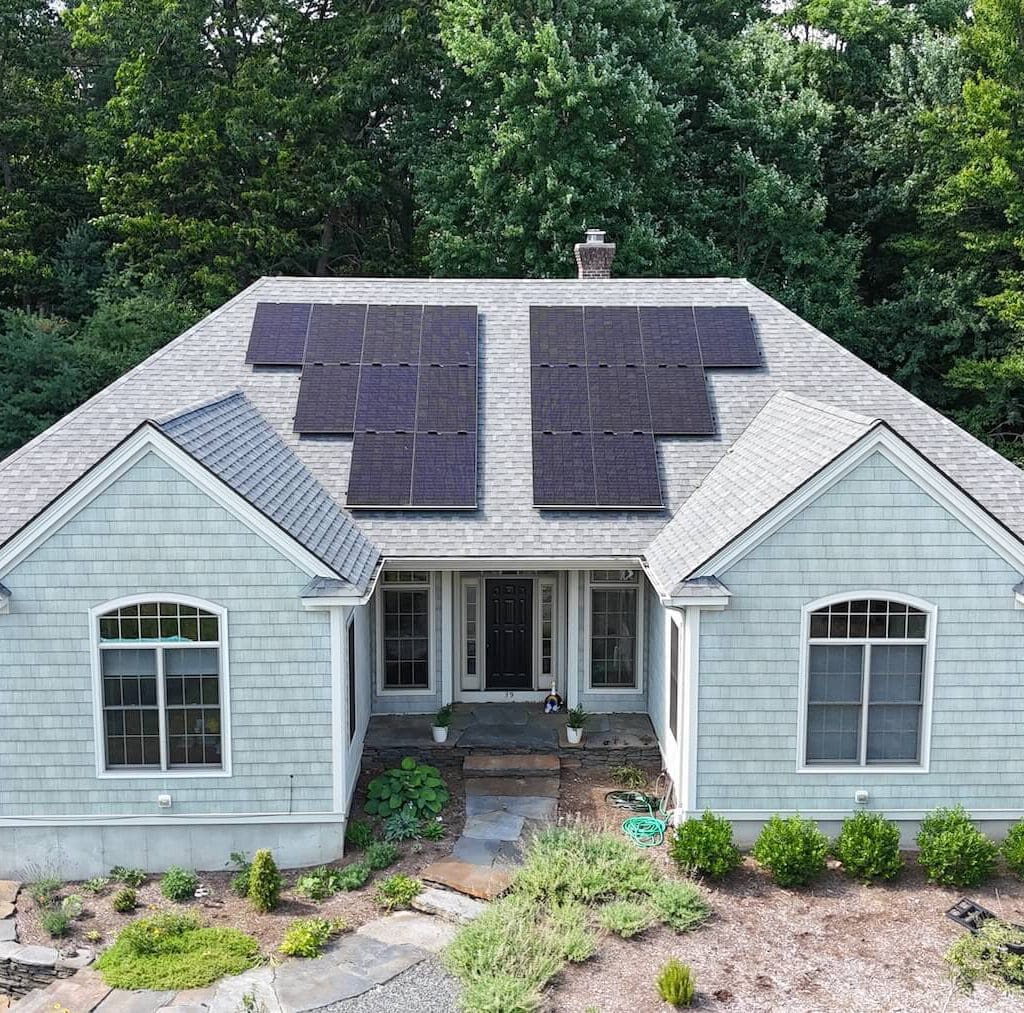
Start with the constraints
Before deciding how much solar you want, it’s important to understand what your home can realistically support.
Every project begins with physical limits. A good design works within them.
1. Physical constraints
How much usable roof or ground space do you have for solar?
System size is often shaped first by physical realities. A proper site assessment looks at:
- Roof size and layout
- Orientation (south, east, west)
- Shading from trees or nearby structures
- Structural considerations
In many cases, your system size is determined simply by how many productive panels can physically fit.
If you have abundant, unshaded roof space, you have more flexibility.
If space is limited, your maximum system size may already be defined.
2. Your electricity “need”
The next step is determining how much electricity your home actually uses.
We look at your past electric bills to calculate total yearly usage in kilowatt-hours (kWh). That becomes the baseline for sizing.
From there, it’s important to think about how your usage may change in the future.
- Are you planning to install heat pumps?
- Buy an electric vehicle?
- Switch to electric cooking?
- Add a hot tub?
- Finish additional living space?
Solar should reflect where your usage is likely headed — not just where it’s been.
3. Budget constraints
Some homeowners approach solar with a specific budget in mind.
That’s completely reasonable.
If your budget does not allow for full offset, a system can still be designed to:
- Fit your investment goals
- Reduce a meaningful portion of your electric bill
- Deliver strong long-term value
Solar does not need to eliminate 100% of your usage to make financial sense.
A well-designed partial system can still be an excellent investment.
4. Regulatory constraints (Massachusetts-specific)
To qualify for net metering, your system must meet Massachusetts guidelines and your utility’s size limits.
As of February 2025, Massachusetts increased the residential net metering limit from 10 kW to 25 kW (AC inverter size). In practical terms, this allows systems of roughly 70–75 panels to qualify automatically — more than most homes can physically accommodate.
For most homeowners in Massachusetts today, roof space, electricity needs, and budget — not regulation — are what ultimately determine system size.
So…Should You Cover 100% of Your Usage?
Many homeowners assume 100% coverage is automatically the goal.
Sometimes it is. Sometimes it isn’t.
Here’s an easy way to approach the decision:
- If you have the space and the electrical need, covering all (or nearly all) of your usage often makes sense.
- If roof space is limited, the practical choice is often the largest productive system that fits.
- If more electrical needs are likely, sizing should account for realistic future growth.
- If budget is the limiting factor, size the system to match your financial comfort.
The right system size comes from balancing all of constraints — not just one or two.
The 115% Sizing Approach
When the goal is to offset nearly all annual electric costs — and sufficient space is available — systems are often designed slightly above your projected yearly usage, typically around 115%.
Why not exactly 100%?
Because in Massachusetts, net metering credits are generally worth about 90% of the retail value of a kilowatt-hour, plus there is a monthly fixed charge. Designing slightly above projected usage helps ensure that, over the course of a year, solar production offsets essentially all charges on your electric bill.
What about going beyond 115%?
In our experience, installing a system that produces significantly more electricity than a household uses rarely improves long-term value — unless excess credits can be applied to another qualifying electric account.
System Size vs. Annual Production
These two concepts are often confused.
System size (kW) is calculated by multiplying the number of panels by the wattage of each panel. For example, 25 panels at 400 watts each equals 10,000 watts, or 10.0 kW. This represents the system’s theoretical maximum output under ideal conditions.
Annual production (kWh) is how much electricity the system actually generates over the course of a year.
What matters for your bill is annual production.
Two systems with the same kW rating can produce very different yearly totals depending on orientation, shading, and layout. The measure of how productive a system is relative to its size is called the Total Solar Resource Factor (TSRF), often referred to as its “Solar Score.” This value is expressed as a percentage, with 100% being perfect.
Production — not panel count — determines real-world performance.
To see how solar production is measured and validated in the field — including Solar Score modeling and LiDAR-based shading analysis — explore our engineering assessment process.
Can I Change the System Size Later?
Sometimes.
In our experience, roughly one in six projects involved a system expansion after the initial installation. Household needs change — electric vehicles are purchased, heat pumps are added, or usage increases over time.
However, expansion is not always simple. Adding panels later typically requires:
- New engineering review
- Updated utility applications and municipal permits
- Additional inspections
Small expansions can also trigger equipment upgrades, which are often not financially practical.
Expanding later is possible, but planning for realistic future electrical needs upfront is usually the more efficient and cost-effective approach.
Batteries, on the other hand, are generally more straightforward to add later.
Key takeaways
Most residential solar systems tend to fall into one of three general outcomes:
- Maxed Out by Roof Space – The largest productive system that physically fits.
- Sized to Match Need (Often Around 110–115%) – Designed to offset nearly all annual electricity usage.
- Sized to Fit Budget – Designed to align with financial comfort while meaningfully reducing usage.
There isn’t a universally “correct” size in practice. The right size is one that fits your home, your plans, and your budget.
A note about working with Valley Solar
Valley Solar helps homeowners think through sizing decisions carefully and without pressure. Our role is to make sure the system fits your home, your usage, and your long-term plans.
If you’d like help evaluating what size makes sense for your home, contact our team.